
Dear subscribers,
This week, we unpack a series of pivotal shifts shaping Indonesia’s digital landscape, from a new cross-border data agreement with the United States and evolving digital tax commitments, to the rise of venture debt as startups seek smarter capital strategies. At the same time, Telkom Indonesia is doubling down on data center expansion, reinforcing the country’s ambition to anchor more digital infrastructure domestically. Beyond policy and infrastructure, Southeast Asia is entering a defining phase in its AI journey as enterprises move from experimentation toward scaled implementation, positioning the region as a strategic battleground for global technology players.
Thanks for reading RISE by DailySocial! Subscribe for free to receive new posts and support my work.
Most companies don’t need “AI transformation.”
They need starting points. That’s where we come in.
No tools pushed. No automation hype. Just clarity.
If AI is on your agenda this year, start here!

Stay ahead,
DailySocial Team
🚨 What’s New
Indonesia and the United States have taken a decisive step in cross-border data governance.
Under a newly announced trade agreement between President Prabowo and President Trump, Indonesia agreed to allow limited transfers of personal data to the U.S., provided they comply with domestic data protection regulations. The move reduces regulatory ambiguity around cross-border digital operations and signals a stronger alignment with global data flow frameworks. For technology companies, cloud providers, and cross-border platforms, this creates clearer operational pathways while maintaining obligations under Indonesia’s Personal Data Protection Law. The development reflects Indonesia’s growing role in shaping digital trade diplomacy while balancing privacy safeguards.
Alternative financing is gaining traction as venture debt emerges as a stronger funding option in Southeast Asia.
Qverse, a venture debt platform founded by regional ecosystem players, is expanding its strategy to include private credit and larger ticket sizes. Venture debt provides startups with non-dilutive capital, offering founders greater flexibility during market slowdowns and tighter equity funding cycles. The growing adoption of structured financing instruments signals a maturing startup ecosystem that is becoming more sophisticated in capital management. As founders prioritize sustainable growth over aggressive burn, diversified funding options are becoming increasingly strategic.
👏 What’s Exciting
Telkom Indonesia is accelerating its data center ambitions as digital infrastructure becomes a national priority.
The state-backed telco, Telkom Indonesia is actively seeking global partners to expand capacity and strengthen its position in the regional data center market. With demand rising from hyperscalers, enterprise clients, and AI-driven workloads, scaling infrastructure has become a competitive necessity. The company is also reportedly revisiting plans to divest a stake in its data center business, signaling confidence in asset value and investor appetite. This move reinforces Indonesia’s strategic push to anchor more digital infrastructure domestically while attracting international capital.
Digital taxation policy is entering a new chapter amid shifting global trade commitments. As part of the broader U.S.–Indonesia agreement, Indonesia is restricted from imposing discriminatory digital service taxes on major U.S. technology platforms. While the government maintains authority to implement fair and non-discriminatory taxation frameworks, the agreement provides greater regulatory certainty for global digital players operating locally. This clarity may enhance investment confidence and platform expansion within Indonesia’s digital economy. At the same time, policymakers will need to calibrate revenue strategies carefully within evolving international trade norms.
At the India AI Impact Summit 2026, Indonesia pushed for AI development that delivers real societal value beyond technical innovation.
Deputy Minister of Communication and Digital Nezar Patria, Representatives from Indonesia emphasized that the impact of AI should be measured by how it improves public services and fosters equitable access, not just by technological sophistication. This shifts the narrative toward responsible and inclusive AI adoption, which aligns with Indonesia’s large, diverse population and its goal of leveraging digital tools to enhance education, healthcare, and economic opportunities for MSMEs and underserved communities. The message resonates within Indonesia’s broader digital policy framework that seeks to balance innovation with public benefit and underscores the country’s role as an active voice in shaping global tech governance.
🚀 What’s Next: Southeast Asia’s AI Inflection Point: Scaling Adoption, Unlocking Value
The latest industry analysis titled AI in Southeast Asia: An Era of Opportunity, published collaboratively by McKinsey & Company, the Singapore Economic Development Board (EDB), and Tech in Asia, shows that Southeast Asia is entering a decisive phase in its AI journey, shifting from experimentation to scaled deployment across enterprises. The report highlights that the region is no longer just a technology adopter, but an increasingly strategic AI arena attracting both Eastern and Western hyperscalers. Governments are rolling out national AI strategies while enterprises integrate AI into core workflows instead of treating it as isolated pilot projects. Despite strong ambition and rising capital inflows, value capture remains uneven, with many companies still struggling to convert AI momentum into measurable financial returns.
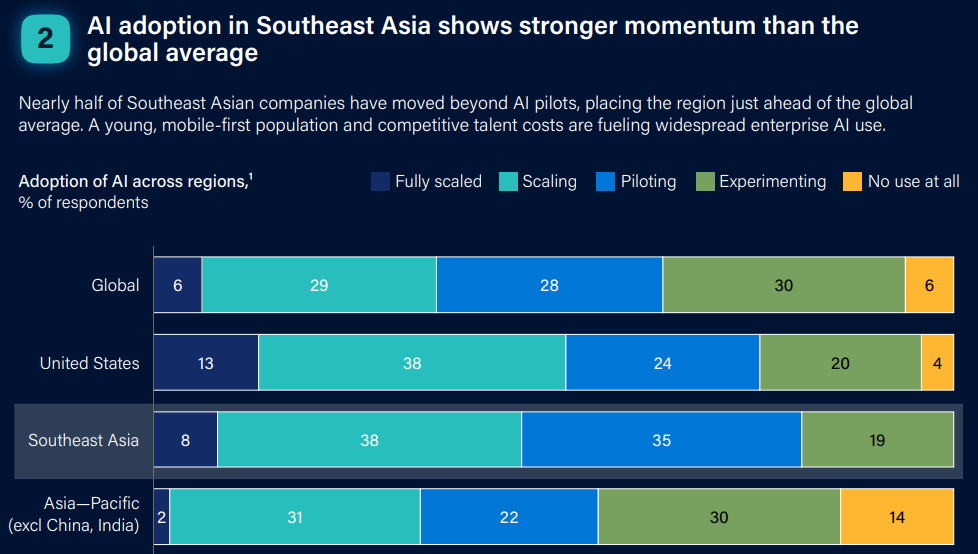
The data reflects both scale and urgency. More than US$50 billion has been invested by hyperscalers in AI-ready cloud and data center infrastructure across Southeast Asia, while nearly half of companies have moved beyond pilot phases, placing the region slightly ahead of the global average in AI adoption. Structural barriers persist, with 20 percent of organizations citing lack of internal expertise as the primary constraint, followed by integration complexity at 16 percent and unclear ROI at 12 percent. Venture investment into Southeast Asia’s AI startups reached US$1.7 billion in 2024, a relatively modest figure compared to broader Asia-Pacific totals, highlighting funding gaps despite ecosystem growth.
For Indonesia, the implications are significant. As one of the region’s largest digital economies with a young, mobile-first population and MSMEs contributing nearly half of GDP, AI adoption will directly influence productivity gains, platform competitiveness, and digital infrastructure demand. The presence of global cloud providers operating data centers in Jakarta, combined with expanding regional connectivity infrastructure, strengthens Indonesia’s position as both a major market and infrastructure node. To fully capture AI-driven economic value, Indonesia must accelerate talent development, enable MSME adoption at scale, and ensure governance frameworks evolve in parallel with enterprise implementation.