
Dear subscribers,
We’re back, and we’re excited. Every week, the Indonesia and Southeast Asia startup ecosystem gives us something new to talk about, and this edition is no exception. We’ve been digging, curating, and getting ready to bring you a fresh mix of stories that we think you’ll love.

So grab a seat, take a moment, and let’s dive in together.
Stay sharp,
The DailySocial Team
🚨 What’s New
Here is a roundup of interesting updates from Indonesia’s startup ecosystem over the past week that you shouldn’t miss:
Doku, Indonesia’s oldest payment gateway, has appointed co-founder Himelda Renuat as CEO, rebranded as Doku by Antom, and announced deeper investment from Ant International. Corporate filings indicate that an Ant-linked Hong Kong holding company controls 72.22% of Doku’s parent, which owns 99.54% of the operating entity, giving Ant an effective stake of about 72%, although the voting structure remains undisclosed under Indonesia’s local-ownership rules. Doku serves more than 300,000 merchants and holds six payment licences, while the partnership will connect its QRIS and domestic payment rails with Antom’s regional network to support multi-currency processing, cross-border payments, and potentially merchant financing. [Read more]
CEO and co-founder Edward Tirtanata, alongside early investor Alpha JWC Ventures and other existing backers, has increased their ownership in Kopi Kenangan through a secondary share transaction reportedly worth around US$70 million, with shares sold by investors including GIC and Peak XV Partners. The deal gives early shareholders an exit while signalling continued confidence in the company, which reported 45% revenue growth to US$184 million, its first annual profit of US$17 million, and 1,324 stores across six countries in 2025. Kopi Kenangan is targeting more than 500 new outlets in 2026, although it has yet to decide on the timing, venue, or valuation of a potential IPO. [Read more]

The CEO of Kopi Kenangan inaugurating the outlet in Taipei / Kopi Kenangan Singapore-based BDx Data Centers has broken ground on CGK4 in Jatiluhur, supported by 845MVA of PLN grid capacity as part of more than 1.2GVA secured across its Indonesian AI campuses. The six-building campus is expected to be developed over three years, with its first building providing 120MW of IT capacity from early 2027 and using direct-to-chip liquid cooling for racks of up to 500kW. Backed by a US$320 million loan facility, the project targets hyperscalers, AI cloud providers, and enterprises while exploring hydropower and other lower-carbon energy sources. [Read more]
Indonesian digital identity and signature provider Privy is broadening its Australian operations beyond electronic signatures with a three-layer digital trust platform covering identity verification, document and action authentication, and Electronic Registered Delivery Services. The expansion supports cross-border transactions amid US$8.92 billion in Indonesia-Australia trade during January-July 2026, with Australian companies including Seek and Woolworths already using Privy’s services. [Read more]

👏 What’s Exciting
Regional dynamics could also have a direct bearing on Indonesia’s startup landscape. Here’s a rundown of the latest developments:
Grab Executives Buy Shares After Atome Deal Sell-Off.
Grab CEO Anthony Tan and President Alex Hungate bought more than US$30 million of the company’s shares after the stock fell about 50% over the past year to a three-year low of US$2.74 following Grab’s agreement to acquire 60% of Atome Financial for US$1.49 billion. Tan purchased around US$29.9 million worth of shares, while Hungate bought approximately US$867,000, signalling management’s confidence in Grab’s strategy despite investor concerns over the BNPL acquisition and the company’s planned US$900 million share buyback. Grab shares subsequently rose 8.9%.
Grab CEO Anthony Tan / Grab Lightspeed Targets US$250 Million India & SEA AI Fund.
Lightspeed Venture Partners is raising Lightspeed India Partners V, a US$250 million early-stage fund focused on AI startups in India and Southeast Asia, with 80% of the target already committed. The vehicle is half the size of its 2022 predecessor and is expected to begin investing within two months over an approximately two-and-a-half-year period, reflecting Lightspeed’s view that AI could create more value in India than the internet did while bringing its regional fundraising cycle closer to its global operations.

🚀 What’s Next: Southeast Asia’s Startup Funding Rebound
Southeast Asian startups raised US$7.25 billion across 217 equity deals in the first half of 2026, according to DealStreetAsia and Kickstart Ventures, the strongest half since early 2022 and nearly four times the US$1.86 billion of a year earlier. One round did most of the work: DayOne Data Centers, the Singapore-based operator spun out of China’s GDS Holdings, closed a US$4.5 billion raise that alone supplied 62% of the total. Strip it out and the region raised US$2.75 billion, up about 48%, while deal count fell 5% to its lowest level since 2018, some 62% below the 572 transactions of H1 2022.
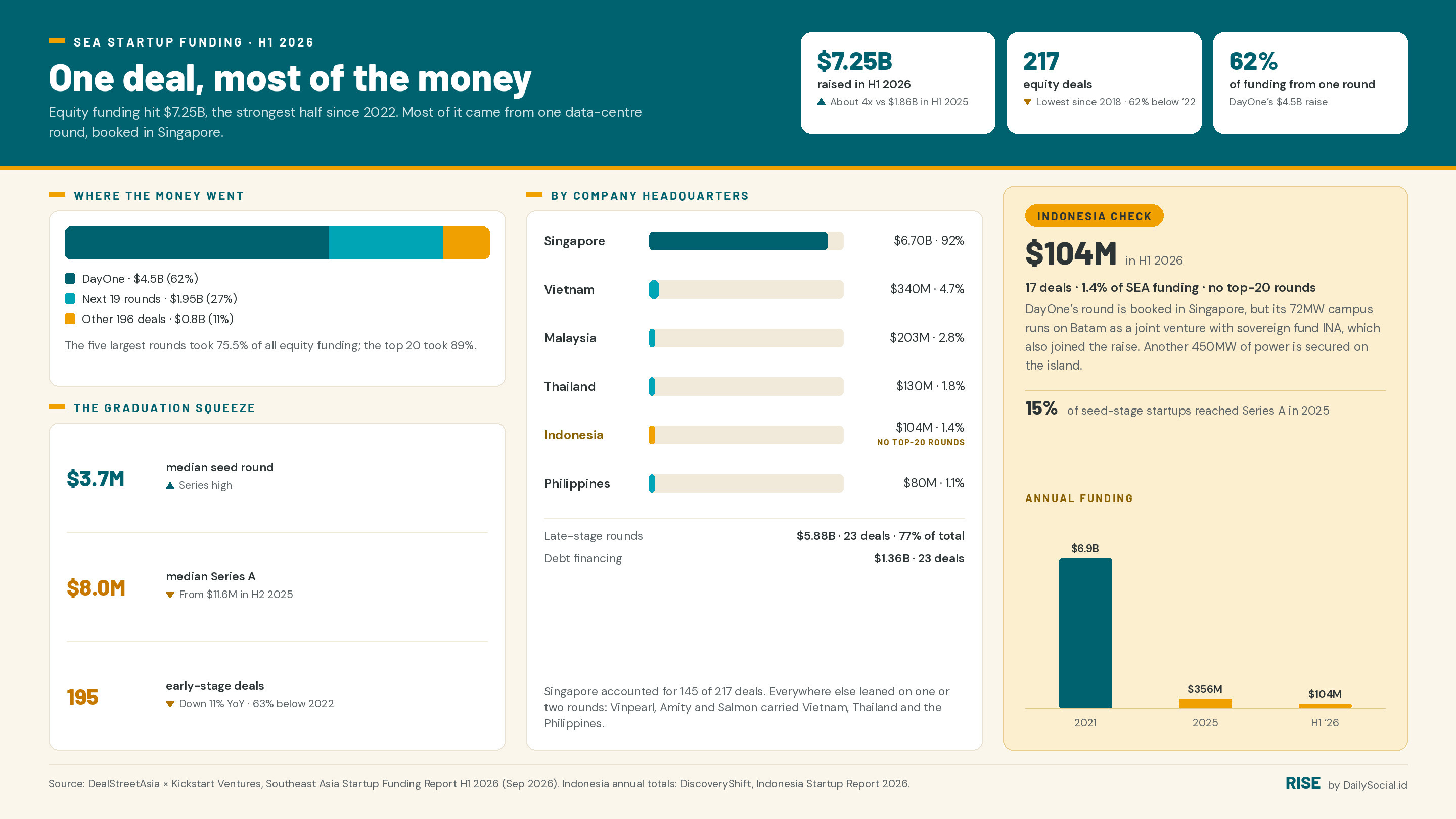
The money that did arrive was tightly held. The five largest rounds took 75.5% of all equity funding, the top 20 took 89%, and the remaining 196 companies shared roughly US$800 million. Singapore-headquartered firms captured US$6.7 billion, or 92%, across 145 deals, while every other market rested on one or two cheques: Vinpearl provided three-quarters of Vietnam’s US$340 million, Amity most of Thailand’s US$130 million, Salmon three-quarters of the Philippines’ US$80 million, and Malaysia showed the widest activity at just 27 deals worth US$203 million.
The stage data is where founders should look. Early-stage deals fell 11% to 195, roughly a third of their 2022 level, even as early-stage capital rose 56% to US$1.72 billion; the median seed hit a record US$3.7 million while the median Series A shrank to US$8 million from US$11.6 million in H2 2025. Investors are writing larger cheques to fewer companies, and graduation, not seed money, is now the choke point. Kickstart’s Minette Navarrete argues deal volume, not headline value, is the true gauge of momentum, and on that measure the recovery has not broadened.
Indonesia illustrates the imbalance best: US$104 million across 17 deals, 1.4% of the regional total and zero top-20 rounds, down from a US$6.9 billion peak in 2021 and US$355.7 million in all of 2025, with the eFishery collapse and June’s TaniHub verdicts still freezing growth capital. The twist is that DayOne’s round is booked in Singapore while its 72MW Batam campus runs as a joint venture with INA, which also joined the raise, and another 450MW is secured on the island. Indonesian land, power and state capital sit inside the region’s headline deal; none of it counts as Indonesian. Capital is back in Southeast Asia. For most founders, the winter has simply turned selective.