
Dear subscriber,
This week's edition captures Indonesia's digital economy quietly turning a corner across profitability, capital, and policy at once. GoTo, Bukalapak, and Blibli all delivered clean Q2 profitability prints, while Superbank, Kopi Kenangan, and Indosat added equally strong scaled results across fintech, F&B, and telco. On the deal and policy side, Pertamina Geothermal locked in fresh Mizuho financing, Brick entered advanced M&A talks with an Australian fintech, S&P held Indonesia's investment-grade rating, Danantara officially joined the Financial System Stability Board, and INA cracked the global SWF top tier. Add Brookings' new framework for how governments across the region should decide on EdTech, and the picture is clear: Indonesia is quietly building the operating discipline, capital credibility, and policy scaffolding its next chapter will run on.

Great products win customers, but strong governance wins investors and survives crises.
The first session of the Road to HATCH Webinar 2026 is designed to equip early-stage founders with the essential governance tools needed before seeking funding or scaling up.
Featuring Fajrin Rasyid, Co-Founder of Bukalapak, this session will demystify founder agreements, financial separation, and healthy decision-making based on his real-world journey building a unicorn. Mark your calendar for Thursday, August 6, 2026, at 19.00 WIB. This online webinar is free but slots are limited, so register immediately at https://s.id/roadtohatch to secure your place.
Thanks for reading RISE by DailySocial!
Stay ahead,
DailySocial Team
🚨 What’s New
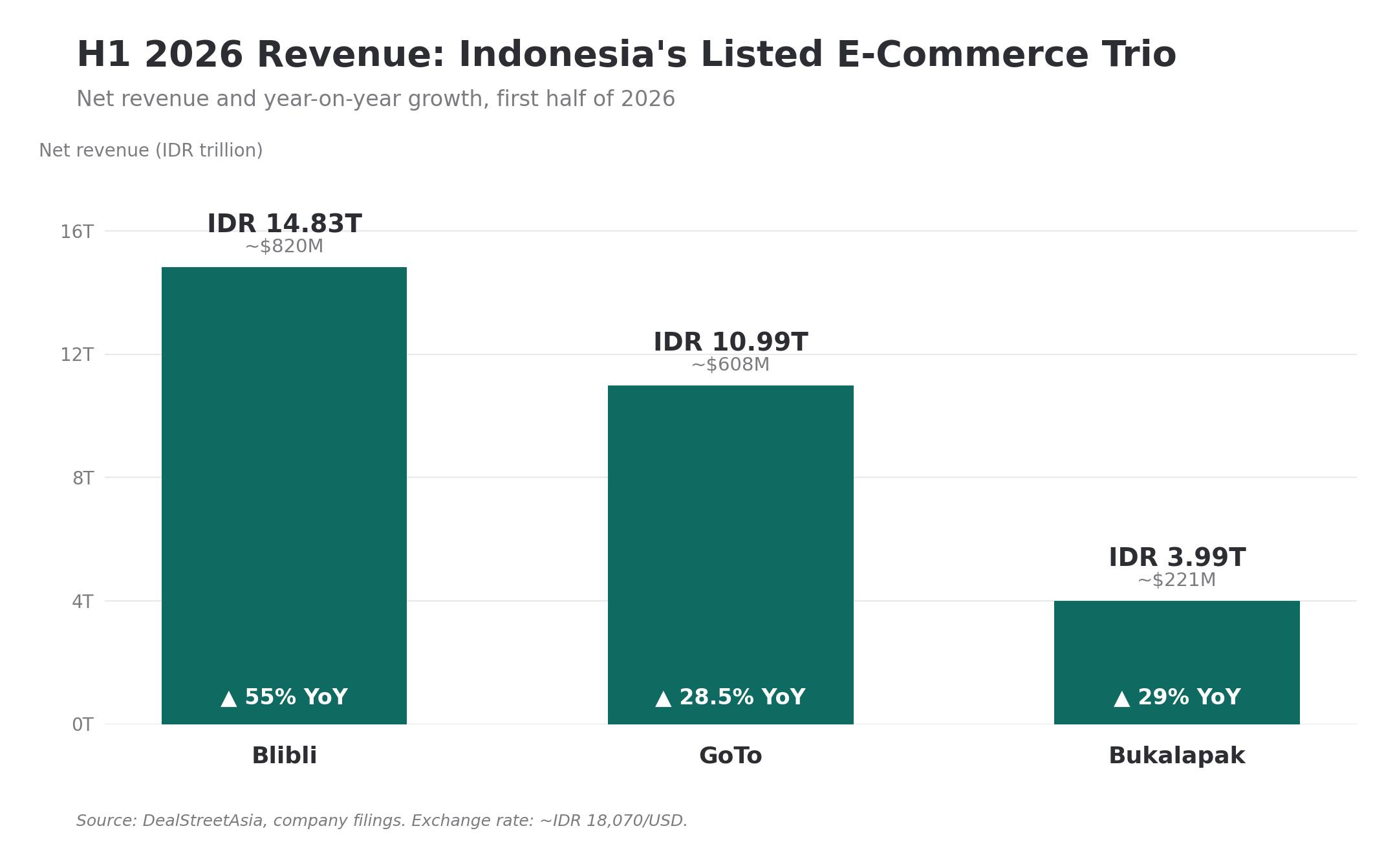
Indonesia’s E-Commerce Trio All Cross Into the Profitability Chapter. Q2 2026 earnings from Indonesia’s three largest listed e-commerce names told the same story with striking consistency. GoTo logged its second consecutive quarterly profit driven by fintech acceleration, taking H1 net profit to $23 million, even as analysts flagged the 8% commission cap as the next test that fintech will now be asked to help absorb. Bukalapak extended its positive adjusted EBITDA streak with H1 revenue up 29% to IDR 3.99 trillion ($220.8 million) as gaming now drives around 85% of quarterly revenue, while Blibli sharply narrowed its Q2 loss with Q2 revenue up 43% to IDR 6.99 trillion ($387 million) and H1 operating loss down 57%. Seeing all three big platforms reporting on the same theme of disciplined profitability in the same quarter is a healthy structural signal that Indonesia’s tech listing market has fully left the era of open-ended growth spending behind.
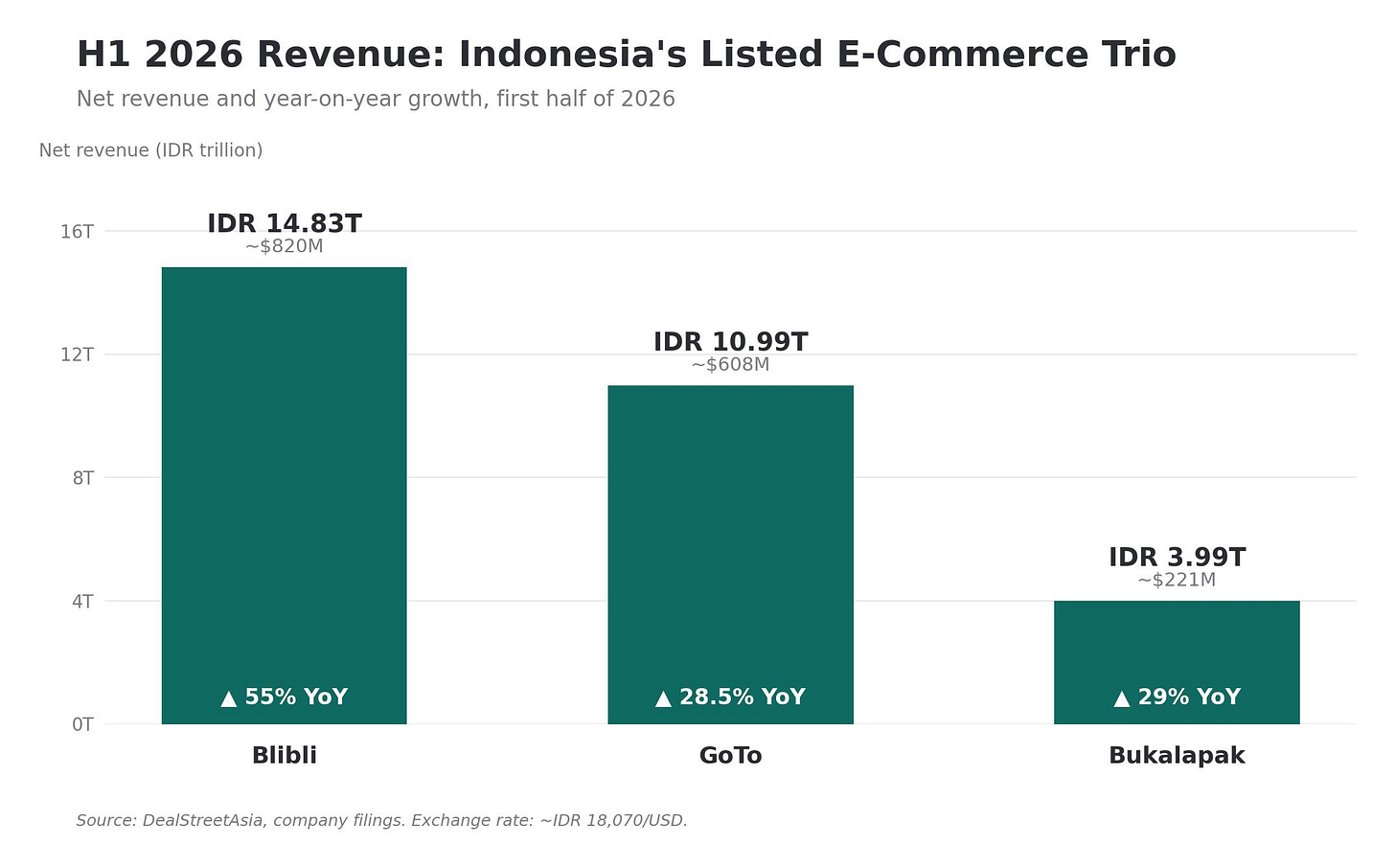
Fintech, Telco, and F&B All Deliver Scaled-Profitability Prints in the Same Week. The rest of Indonesia’s listed digital cohort matched the e-commerce trio with equally clean results across financial services, telco, and consumer. Grab’s Superbank posted a 33% jump in Q2 pre-tax profit to IDR 134 billion ($7.4 million), taking H1 net profit to IDR 182.6 billion, more than seven times a year earlier, as loans grew 61% and customers crossed 7 million. Indosat’s H1 revenue rose 13.1% to IDR 30.7 trillion ($1.7 billion) with normalised net profit up 49.2%, powered by an AI Cloud business that generated $33 million in H1 alone, already surpassing all of 2025. And Kopi Kenangan booked its first ever annual net profit of $17 million on 2025 revenue of $184 million across 1,324 outlets in six countries, with Indonesian net profit jumping from IDR 80 billion to IDR 377 billion. Read together, this is Indonesia’s next-decade digital economy locking in real operating leverage across every layer of the stack.
Brick Is in Advanced Talks to Sell a Majority Stake to an Australian Fintech. Indonesian open-finance and data-connectivity fintech Brick is reportedly in advanced talks to sell a majority stake to an Australian fintech firm that has emerged as the frontrunner over several global suitors. Brick has become a go-to infrastructure provider for financial services companies embedding real-time bank data, credit signals, and open-banking flows into their products, quietly underpinning credit scoring, digital lending, and insurance rails across the ecosystem. If the transaction closes, it will mark one of the more meaningful inbound acquisitions of an Indonesian fintech infrastructure name, signalling that global strategic capital now views this layer as durable enough to buy outright. Expect more inbound moves as Indonesia’s foundational fintech layer matures into an M&A-ready category.
Pertamina Geothermal Locks in a $75M Trade Facility from Mizuho Bank Indonesia. PT Pertamina Geothermal Energy (PGE), Indonesia’s dominant geothermal power producer, has signed an uncommitted $75 million omnibus trade facility with Bank Mizuho Indonesia to support operations and expansion projects. The unsecured, clean-basis facility bundles bank guarantees, standby and import letters of credit, accounts-payable financing, and a revolving loan, giving PGE meaningful flexibility as it scales toward its 1 GW installed capacity target by 2028 and 1.8 GW by 2034. The deal follows $477.9 million in concessional financing that PGE secured in June from JICA and the World Bank, cementing its position as a magnet for international clean-energy capital. Alongside Barito Renewables’ recent $300 million Bangkok Bank facility, geothermal has clearly become the crown-jewel sector where global project finance is flowing back into Indonesia with real conviction.
Telkom Weighs Sale of MDI Ventures as Indonesia’s Corporate VC Landscape Enters a New Chapter. TelkomMetra, a subsidiary of Telkom Indonesia, is reportedly weighing a sale of its corporate venture arm MDI Ventures, which manages $830 million in committed AUM across more than 80 portfolio companies including six unicorns such as Kredivo and Nium. According to reports, Jefferies has been engaged to advise on the process, though it remains early-stage with no final decision made. MDI’s fund base draws institutional capital from South Korea, Singapore, and Norway, making it one of the region’s largest state-linked corporate VCs. A potential transaction would mark a structural shift for Indonesia’s corporate VC landscape, freeing MDI’s mature portfolio for new stewardship and allowing Telkom to redirect capital toward its core telecoms and AI-infrastructure priorities. Well-managed transitions like this are exactly how corporate VC ecosystems typically mature.
👏 What’s Exciting
S&P Reaffirms Indonesia’s Investment-Grade Rating Even as Policy Uncertainty Rises. S&P Global Ratings has affirmed Indonesia’s BBB/A-2 sovereign credit rating with a stable outlook, even as the abrupt resignation of Bank Indonesia governor Perry Warjiyo introduced fresh uncertainty into the monetary policy outlook. S&P said the leadership change does not directly impact Indonesia’s rating and expects fiscal and external pressures to ease as policy implementation stabilises. That affirmation matters even more given Moody’s and Fitch cut their outlooks to negative earlier this year, making S&P’s stable stance a valuable anchor for foreign investor confidence in Indonesia’s growth agenda. For a country pursuing an 8% GDP growth target with major fiscal reforms in play, keeping S&P onside is a meaningful signal that credit markets still trust Indonesia’s macro trajectory.
Danantara Officially Joins Indonesia’s Financial System Stability Board. Indonesia’s sovereign wealth fund Danantara will formally join the country’s Financial System Stability Board, giving the fund a direct seat in the body that oversees financial-sector stability alongside the finance ministry, the central bank, OJK, and the deposit insurer. The board meets at least quarterly to assess systemic risks and coordinate crisis-response measures, and Danantara chief Rosan Roeslani said the inclusion means the fund can now have direct impact on the real economy rather than just the fiscal and monetary channels in isolation. This is a meaningful institutional upgrade, embedding a sovereign fund with real dry powder directly into Indonesia’s crisis-response architecture for the first time.
🚀 What’s Next: Brookings and ADB Just Published the Sharpest Analysis of How Southeast Asia Actually Decides on EdTech.
A new report from the Center for Universal Education at Brookings, authored by Molly Curtiss Wyss and Brad Olsen and supported by the Asian Development Bank, takes a hard look at how governments across South and Southeast Asia actually pick and scale their edtech investments. The central argument is refreshingly honest: today’s decisions across the region tend to prioritise motivation (political signalling, donor pressure) and feasibility (what is easy to roll out quickly) over sustainability and evidence. But the report reads less as a critique and more as a roadmap. With small shifts in how governments frame their edtech decisions, the benefits can outweigh the risks, and the same investments can deliver meaningfully better learning outcomes across the region.
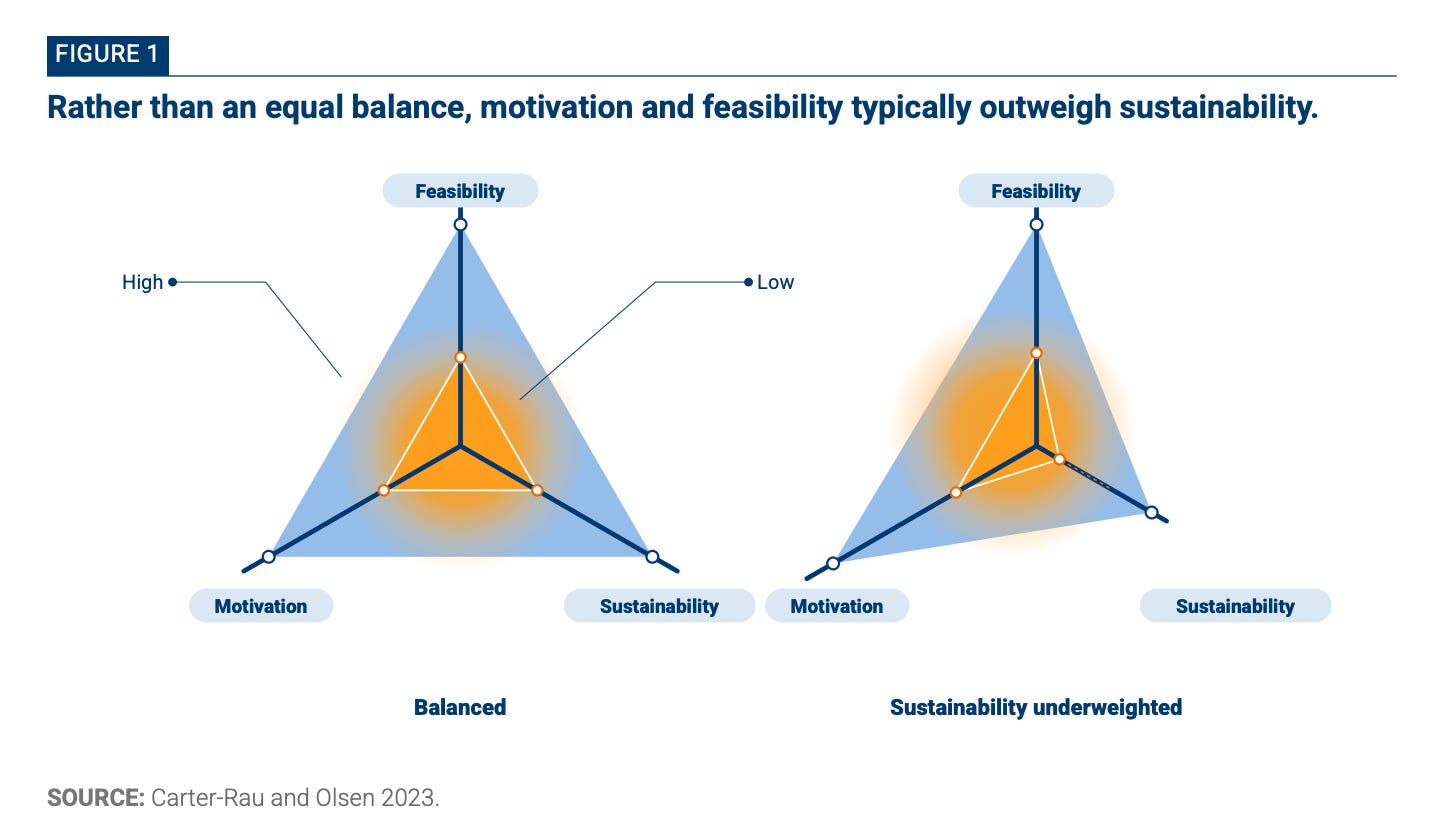
The methodology is rigorous and the framework is genuinely usable. The report synthesises a purposeful review of 57 academic publications and institutional reports with 12 semi-structured interviews across government, private sector, research bodies, and multilateral organisations, spanning 14 countries including Indonesia, India, Malaysia, the Philippines, Thailand, and Vietnam. Its analytical spine is the three-dimension decisionmaking framework: motivation, feasibility, and sustainability. From this, the authors offer six concrete recommendations that map neatly onto real-world policy work, including starting design from the hardest-to-reach users and settings, focusing on the intended learning purpose rather than the shiny product, strengthening institutional capacity as a core scaling strategy, investing in contextualisation with teachers and communities, prioritising interoperability and system coherence, and funding better impact data on effectiveness, relevance, inclusion, and sustainability.
For Indonesia, this framework lands at exactly the right moment. The country is deep into Kurikulum Merdeka implementation, Kemendikbud and Komdigi are both making major digital-learning calls, and a large private edtech cohort from Ruangguru to Zenius continues to shape adoption on the ground. The report also spotlights a distinctly Indonesian equity gap that most edtech strategies still overlook: roughly 3.3 million students attend pesantren, and most digital learning models are built for formal schooling environments rather than the community-based traditions of Islamic boarding schools. That is a huge, structurally underserved audience where thoughtful, low-cost, contextualised edtech could deliver real learning gains. Applied well, the Brookings framework gives Indonesia a genuinely constructive path to close its remaining edtech equity gaps, scale its most promising innovations sustainably, and turn the country’s digital-learning ambition into measurable, lasting impact.