
This week, Indonesian tech is crossing borders with confidence. Privy is taking its digital trust services to Australia, while Sociolla is bringing homegrown beauty brands to Singapore. At home, INA is backing clean energy, Danareksa Investments is scaling up after a state fund merger, and Lintasarta is offering regulated industries a local route to AI. Google, Meta and TikTok are pushing back on a proposed news payment law as lawmakers shape the region’s first AI copyright rules. In our deep dive, we look at how Indonesia’s digital banks are turning their parent ecosystems into profit.
Stay sharp,
The DailySocial Team
Whats new
Privy Takes Indonesian Digital Trust to Australia
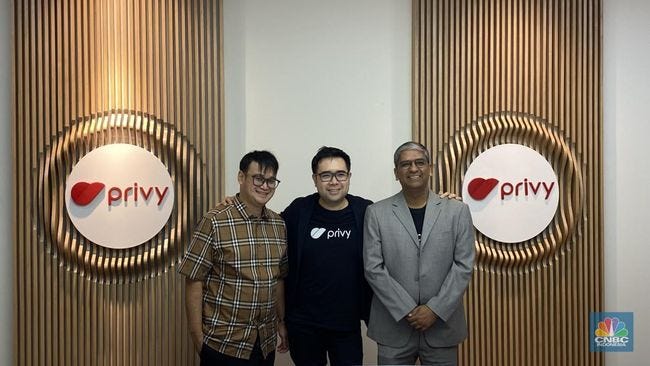
Privy, the Jakarta company behind certified digital signatures and identity checks for more than 40 million users, has signed a new digital trust partnership in Australia. It has been building there since 2023, when it became the first Indonesian tech firm to export its digital identity operations to the country. Its Australian platform now works with ConnectID, Australia’s national digital identity network, and covers identity checks, signing and proof of who approved what. With trade between the two countries reaching US$8.92 billion in January to July 2026, trusted cross-border paperwork is a natural export for Indonesian tech.
Sociolla Brings Indonesian Beauty to Singapore
Beauty retailer Sociolla has opened its first two Singapore stores, at Funan and Bugis Junction, stocking more than 130 brands. More than 40 of them are new to Singapore, and the company plans to keep adding labels from Indonesia and the wider region. Sociolla already runs more than 200 stores at home and has been in Vietnam since 2020. With local labels making up 55% of its range in Indonesia, the move gives homegrown beauty brands a shop window in one of Asia’s most competitive retail markets.

INA Backs Vena’s Regional Clean Energy Push
Indonesia Investment Authority (INA), the country’s sovereign wealth fund, has invested in a 2.8-gigawatt portfolio of solar and wind projects in Indonesia and the Philippines developed by Singapore’s Vena Group. The portfolio spans operating, under-construction and development-stage assets, including the 72-megawatt Tolo wind farm in South Sulawesi. The amount was not disclosed. For Vena, backed by BlackRock’s Global Infrastructure Partners, long-term partners free up capital to build more projects, while INA gains a ready platform for the energy transition at home.
Danareksa Investments Aims Big After State Fund Merger
Danantara has merged the fund management arms of Mandiri, BRI, BNI and PNM into Danareksa Investments, which now manages Rp172.5 trillion. The new firm targets Rp192 trillion to Rp200 trillion (about US$11 billion) by 2027, while Danantara chief Rosan Roeslani wants it to reach Rp350 trillion within three years. It already serves more than one million retail investors and 375 institutions, and is expanding abroad through a Singapore arm. A larger local asset manager could help deepen Indonesia’s capital market at a time when it needs more domestic money.
Whats exciting
Big Tech Pushes Back on Indonesia’s News Payment Plan
Google, Meta and TikTok told lawmakers on November 11 that they oppose planned copyright law changes that would require platforms to pay publishers for news shown on their services. The bill would also set rules for AI, making Indonesia the first country in Southeast Asia with an AI copyright law. The platforms argue that paying for links could limit access to news, while press groups say journalists need stronger legal protection. The bill builds on a 2024 presidential regulation on publishers’ rights and is still being drafted, leaving room for a model that works for both newsrooms and platforms.
Lintasarta Relaunches Its Sovereign AI Push
Lintasarta, the IT services arm of telco Indosat, has relaunched its sovereign AI offering under the Merdeka AI banner, built on its Cloudeka cloud and local data centres. Sovereign AI means companies can use AI while keeping sensitive data and computing inside Indonesia. The firm also earned ISO/IEC 42001 certification in October, a global standard for managing AI systems responsibly. With banks and government agencies required to keep data onshore, a homegrown option makes AI adoption easier for regulated industries.
MSCI Trims Indonesia, but the Reform Clock Is Still Running
Index provider MSCI has removed Barito Pacific, the energy and petrochemicals group, and Bumi Resources Minerals from its main global index, with Bumi Resources Minerals moving to the small-cap index. Seven more Indonesian stocks are leaving the small-cap index, with all changes taking effect after trading on November 30. Analysts expect the direct market impact to be limited. More importantly, MSCI’s separate review of whether to downgrade Indonesia to “standalone” status runs until mid-2027, giving regulators time to prove their reforms are working.
Whats interesting: Indonesia’s Digital Banks Turn Ecosystems Into Profit
Indonesia’s digital banks are posting solid profits, even as the gap between the leaders and the rest widens. Sea Group’s SeaBank led the pack with nine-month net profit of Rp1.11 trillion, up 172%, according to the banks’ third-quarter financial reports. Grab-backed Superbank grew profit almost fivefold to Rp299.9 billion, GoTo-backed Bank Jago rose 49.7% to Rp298.1 billion, and Krom Bank gained 25% to Rp157.9 billion. Akulaku’s Bank Neo Commerce and CT Corp’s Allo Bank remain among the most profitable, at Rp431 billion and Rp338.1 billion, despite slips of 7% and 11%.
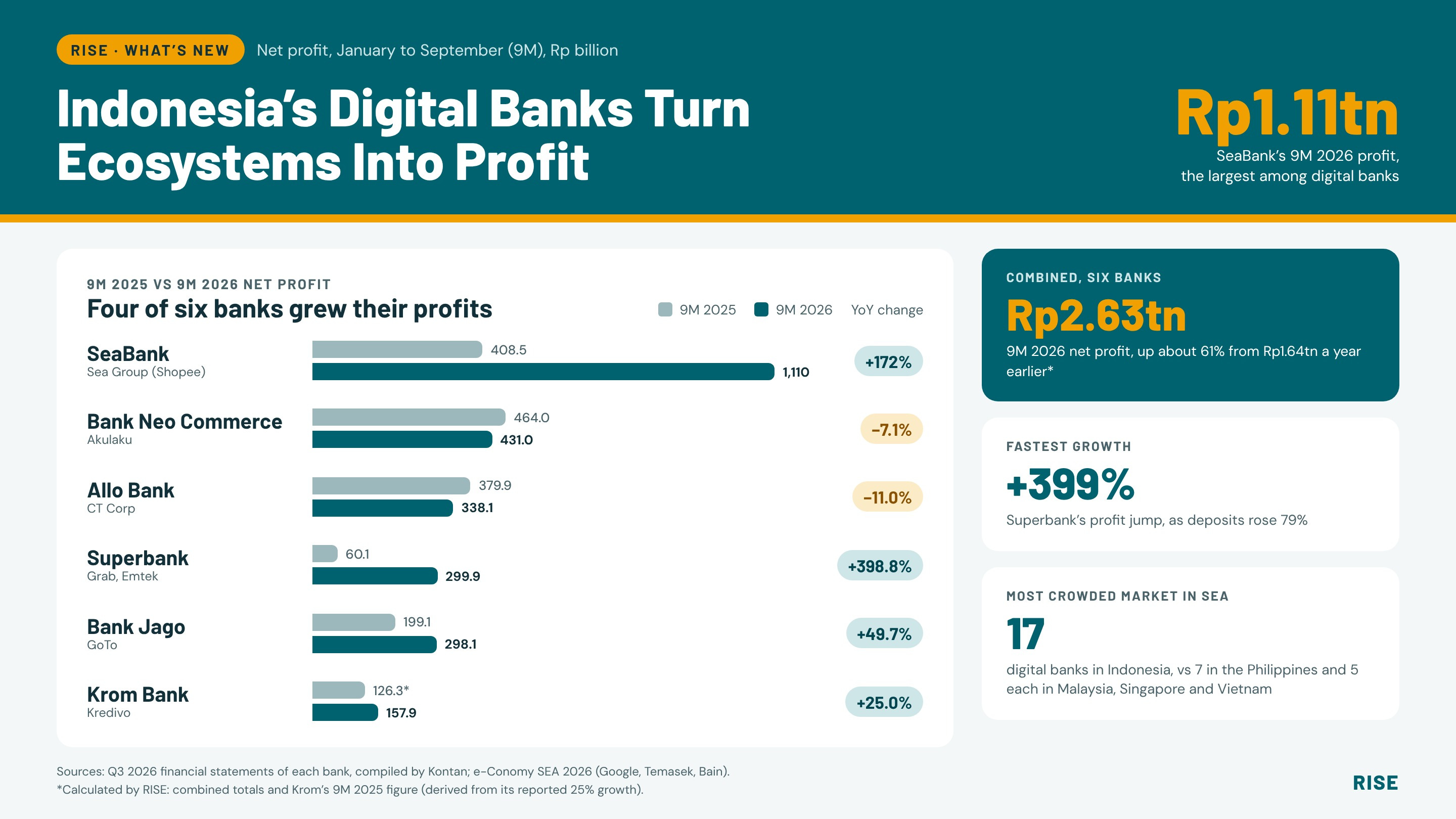
The winners share one formula: they draw customers and cheap deposits from a parent platform, then lend to that same base. Superbank’s deposits jumped 79.3% as it plugged deeper into Grab’s ecosystem, while Bank Jago earns strong interest income from a deposit base dominated by low-cost savings accounts. The two decliners are not losing revenue. Allo Bank’s net interest income rose 16.1%, but higher provisions for bad loans ate into profit, while Bank Neo Commerce chose to shrink lending by about 10% to focus on loan quality.
Indonesia’s 17 digital banks form the largest field in Southeast Asia, and the e-Conomy SEA 2026 report finds they reach profitability faster than peers in Singapore and Malaysia. Competition for deposits keeps funding costs high, but the Indonesian Banking Development Institute (LPPI) still sees a positive outlook through year end for banks with strong transaction ecosystems, cheap funding and disciplined credit risk. For founders and investors, the lesson is clear: in Indonesian fintech, distribution and data are proving as valuable as the banking licence itself.