
Dear subscribers,
We’re back with another edition of RISE, and the Indonesia and Southeast Asia startup ecosystem is buzzing with news that matters. From fresh funding rounds and major corporate shake-ups to new partnerships and a reality check on innovation, this week’s stories are all about momentum, money, and the moves shaping what comes next.

Let’s get into it.
Stay sharp,
The DailySocial Team
🚨 What’s New
Here is a roundup of interesting updates from Indonesia’s startup ecosystem over the past week that you shouldn’t miss:
Indonesian digital lender JULO has secured new funding with participation from an investment arm of Saratoga Investama Sedaya and existing investors including Saison Capital, ACV Capital, Quona Capital, and Skystar Capital. The Jakarta-based fintech, which surpassed US$1.7 billion in lifetime disbursements by late 2025, continues to expand its OJK-licensed digital revolving credit and virtual credit card platform after previously raising a US$80 million Series B from Credit Saison in 2022. [Read more]
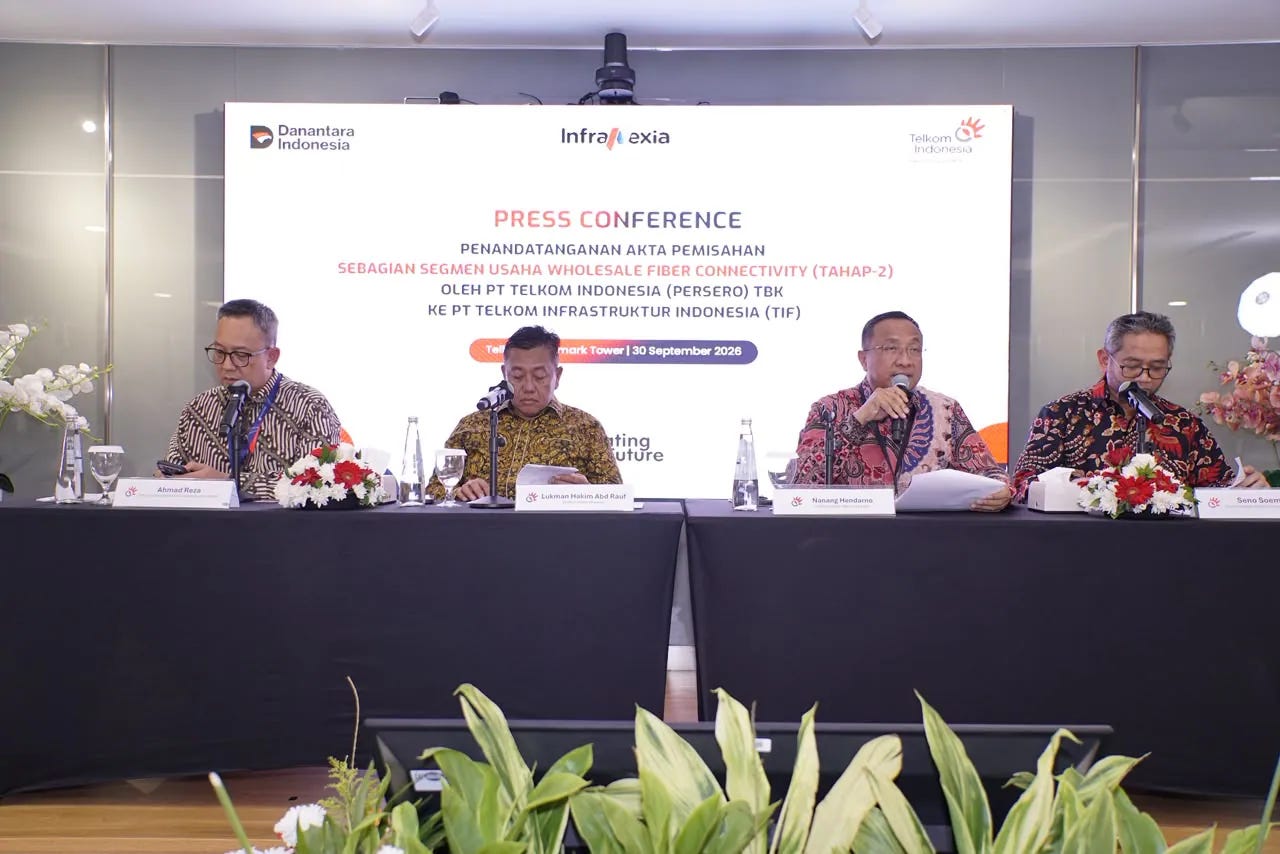
PT Telkom Indonesia has obtained independent shareholder approval to spin off more than 90% of its network infrastructure assets to InfraNexia, consolidating around 112,000 km of fiber optic and 26,000 km of domestic subsea cable in a transaction valued at about Rp85.7 trillion (US$4.8 billion). The move, formalised through a deed of separation on September 30, 2026, is intended to sharpen Telkom’s focus as a strategic holding company while positioning InfraNexia as a carrier-neutral wholesale platform for connectivity, FTTx, and AI-ready infrastructure; the RUPSLB also approved a new board led by Commissioner Angga Raka Prabowo and CEO Nanang Hendarno. [Read more]
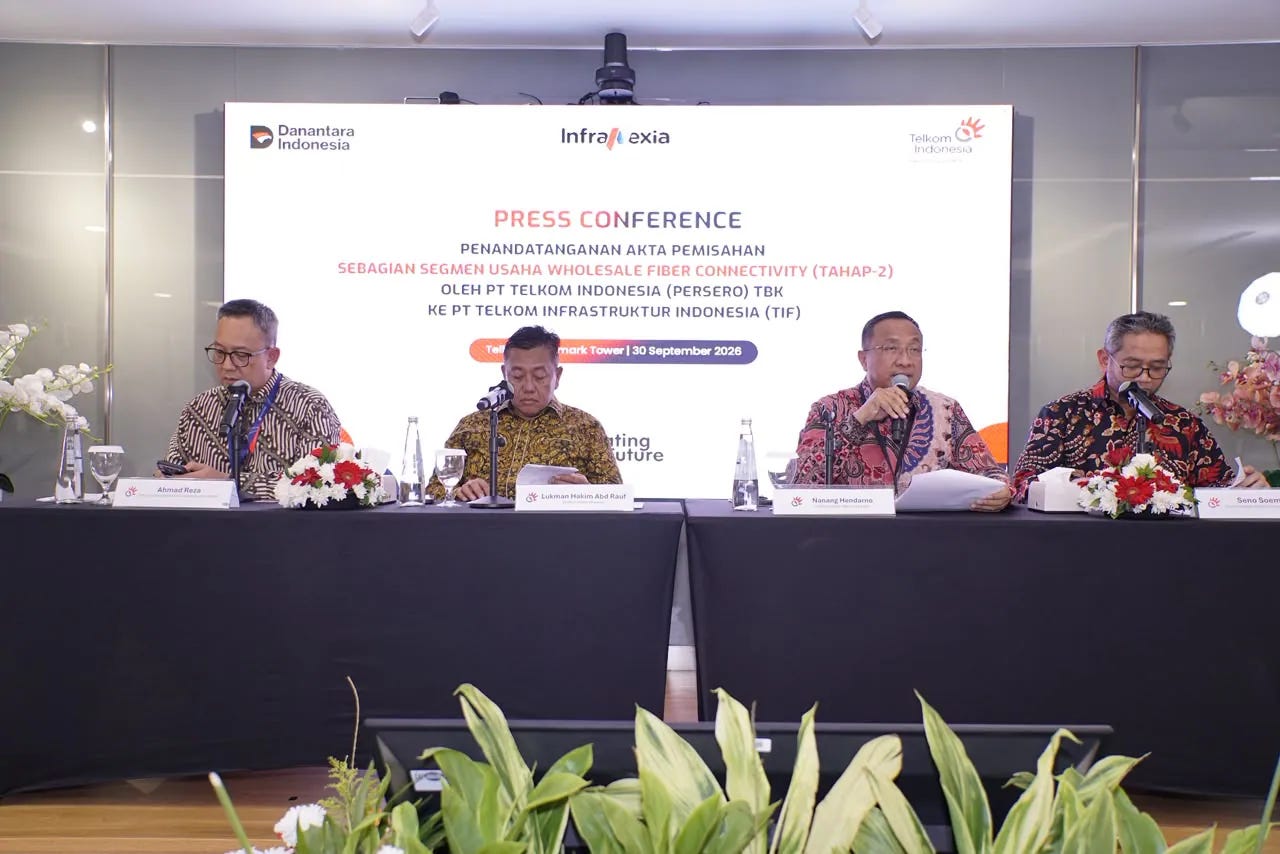
Telkom’s 2026 Extraordinary General Meeting of Shareholders Approves InfraCo Spin-Off and Management Changes, Appoints New President Director / Telkom Digital Realty Bersama (DRB), the data centre joint venture between Saratoga Group and US-based Digital Realty, has appointed former CENT president director Raymond Yan to lead its Indonesia operations. Yan, who oversaw CENT’s expansion from around 4,600 to more than 11,000 sites and doubled its fibre network to 5,000 km, will focus on optimising high-density infrastructure and expanding interconnection ecosystems to meet rising demand for AI and high-performance computing workloads. [Read more]
The Directorate General of Taxes has begun enforcing Article 22 income tax withholding on domestic sellers via four designated marketplaces—Shopee, Blibli, Tokopedia, and Lazada—starting October 1, 2026, under Finance Ministry Regulation No. 37/2025. The platforms will withhold 0.5% of gross transaction value (excluding VAT and luxury-goods tax), with individual sellers earning up to Rp500 million annually exempt if they submit the required statement, and the withheld amount creditable against their annual or final income tax. [Read more]
A unit of Tokyo-based SBI Holdings is in discussions to invest in Indonesian B2B payments infrastructure provider Durianpay, reflecting growing Japanese interest in Indonesia’s fintech sector. Durianpay, which processed more than US$5.5 billion in total payment volume in 2025 and recorded its first full profitable year, plans to use the fresh capital to expand beyond Indonesia and develop digital-asset and cross-border money-movement products, including a stablecoin-backed service. The startup has raised about US$8.07 million to date, with its last round of US$6.22 million led by ACV Capital in May 2025. [Read more]
GoTo’s stock fell about 30% to 30 rupiah in early trading after the Indonesia Stock Exchange eliminated its 50-rupiah minimum trading price, allowing shares to trade down to 1 rupiah and releasing pent-up selling pressure after the stock had been stuck at the floor for about four months. The reform, aimed at improving price discovery and liquidity, comes after MSCI removed GoTo from its indexes over low liquidity, even as the company reported a second consecutive quarterly profit in Q2 2026. [Read more]
👏 What’s Exciting
Regional dynamics could also have a direct bearing on Indonesia’s startup landscape. Here’s a rundown of the latest developments:
Singapore-based insurtech Igloo and Indonesian e-wallet DANA have introduced DANA Rain Protection, a parametric weather insurance product embedded in DANA’s QRIS payment flow that pays users 50,000 rupiah (about US$2.8) when rainfall at their location reaches 2.5 mm or more during the coverage period. Priced at 500 rupiah (US$0.028) per policy, claims are validated automatically using satellite precipitation data and GPS coordinates, with no paperwork or manual review, as Igloo reported FY2025 revenue of S$80.9 million (up 45.9%) and a narrowed net loss of S$8.6 million while targeting adjusted EBITDA breakeven by end-2026.
Disney+ and Indonesian platform Vidio have introduced the Vidio Ultimate Disney+ All Screen Bundle, priced at Rp129,000 per month on an annual plan, combining Vidio’s sports rights (including the English Premier League, UEFA Champions League, and BRI Super League) with Disney+’s catalog of Marvel, Star Wars, and other international and Korean titles. The bundle targets premium households and aims to improve retention during football off-seasons, as Vidio leads Indonesia with more than 6 million paid subscribers and positive EBITDA since late 2025, while Disney+ shifts from its earlier Telkomsel-led distribution to partner with the local market leader.

Vidio Partners with Disney+ to Combine Sports, Entertainment, and Family Content in a Single Subscription / Vidio Singapore-based port operator PSA International and Asia-focused private capital firm Granite Asia have created the US$50 million G&P Strategic Innovation Fund to invest in technology companies developing solutions for ports, logistics, and global supply chains. The fund will co-invest alongside Granite Asia’s existing vehicles and is intended to help promising AI, robotics, and automation technologies move from pilot projects to wider commercial adoption, while the broader partnership covers technology insights, venture engagement, talent development, and innovation collaborations.

🚀 What’s Next: Global Innovation Index 2026 Report tells Indonesia holds at 55th, rich in capital, thin in R&D
WIPO’s Global Innovation Index 2026, which ranks 139 economies, opens with continuity at the top: Switzerland leads for a 16th consecutive year, followed by Sweden and the United States, and no new economy broke into the top 15. The structural story is Asia’s entrenchment. Five Asian economies now sit in the top 25, led by South Korea (4th) and Singapore (5th), with China (10th) remaining the only middle-income economy among the innovation leaders.
Indonesia ranks 55th overall, holding that territory for a third straight year, and places 7th among the world’s 35 upper middle-income economies. WIPO again counts it among the seven middle-income economies that have climbed fastest since 2013, alongside China, India, Vietnam, Türkiye, the Philippines and Morocco, and 2026 marks Indonesia’s fifth consecutive year as an innovation overperformer, delivering more innovation than its income level predicts. Within ASEAN, it still trails Singapore (5th), Malaysia (34th), Vietnam (43rd), Thailand (44th) and the Philippines (52nd).
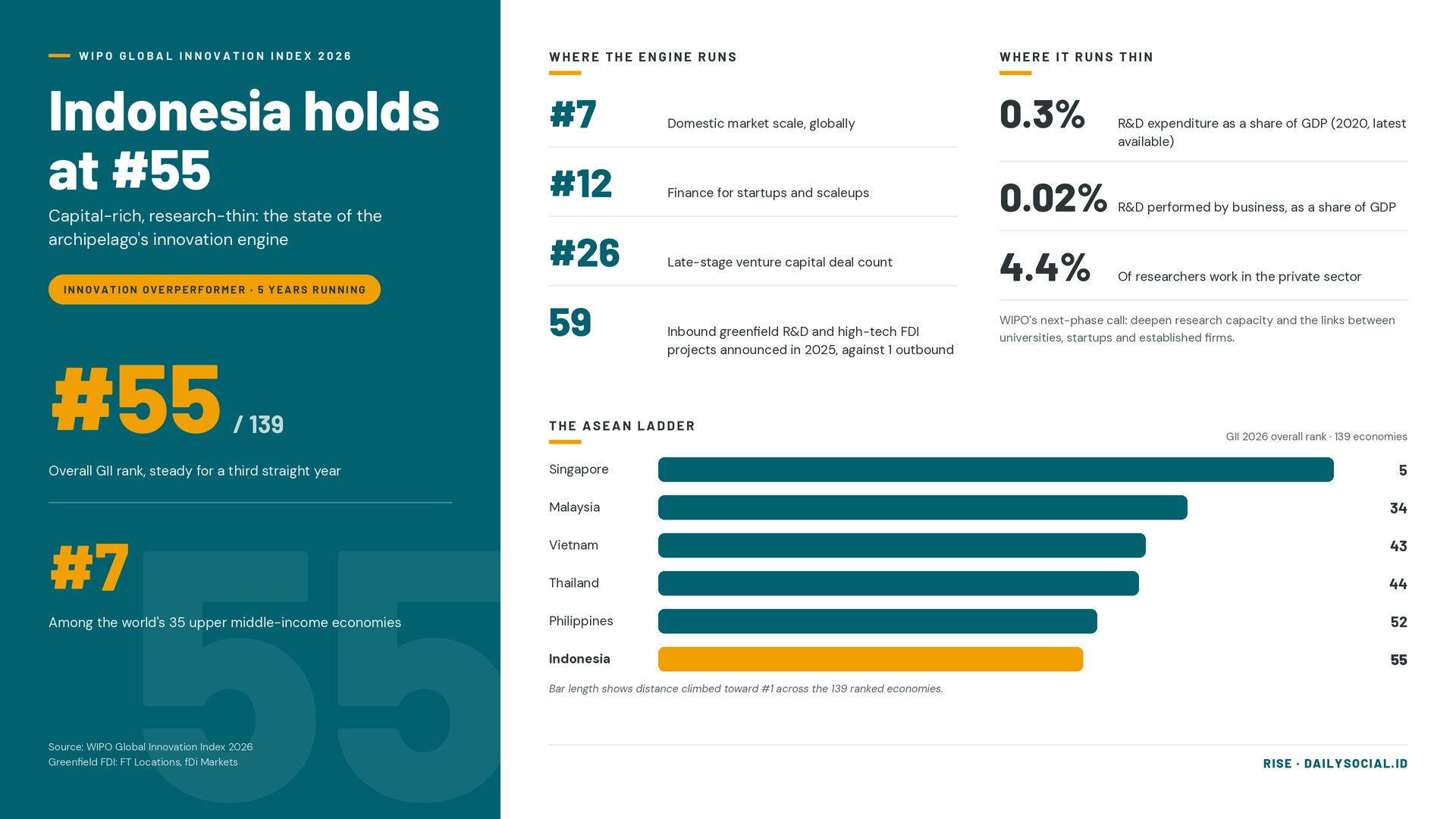
What powers that standing is market scale and capital, not laboratories. Indonesia ranks 7th globally for domestic market scale, 12th for finance for startups and scaleups, and 26th for late-stage venture capital deal count, levels WIPO describes as comparable to high-income economies. The report’s new greenfield R&D and high-tech FDI indicator, built with FT Locations, also tags Indonesia as an “investment magnet”: firms announced 59 inbound R&D and high-tech projects in Indonesia in 2025, against just one outbound.
The constraint is the research base. R&D spending sits at only 0.3 percent of GDP (2020, the latest available figure), business-performed R&D at 0.02 percent, and just 4.4 percent of researchers work in the private sector. WIPO warns that middle-income climbers hit a glass ceiling beyond the top 40 to 50 without deeper research capacity and stronger university-industry-startup linkages. For founders, the read is straightforward: access to capital is no longer Indonesia’s binding constraint; defensible, research-driven products are.